Now bear with me on this. It is a bit meandering, but I made a connection the other day that I don’t know how to explain in any other way, and it is important.
According to Dungeons and Dragons (I believe the originator of the concept) and most video game usage: True Damage is a description of a type of damage that cannot be hindered by armor, magical protection, or any passive defense. To get into the weeds a bit in case any of you are not gamers: If you have a character that has 60 points of health, and you get hit by a sword that will deal 45 points of damage, this is often offset by. things like: Your armor protects you for up to 25 points of damage, and your magic resistance will defer 40% of slicing damage. In this scenario, the 45 points of slicing damage from that sword instantly gets 25 points removed due to the armor, which brings it down to 20. Then the magic resistance you have will defer 8 points of damage. So you actually receive 12 points of damage which is essentially a really uncomfortable scratch. If the weapon deals true damage, it will ignore your armor, it will ignore your magic, and it will deal 45 points of damage which would bring you critically low on health. So you can see how devastating it can be.
From something I realized the other day when talking to a friend, I don’t think True Damage is actually given enough weight in these games.
Let’s talk about my martial art. As you probably know, I train in a samurai art called Nami Ryu Aiki Heiho. This roughly translates to Wave Style Magic Strategy. Translating Aiki is not inaccurate to say Magic, but it is not the clear either. We would say Aiki is anything you cannot do to a chair. You cannot trick a chair, you cannot make a chair think you are striking from the left so you can strike with the right. Deception is a VERY important part of warfare that you cannot perform on a chair. But Deception is also not a good word for it. It is like the rectangle/square scenario, Deception is Aiki, but Aiki is not deception. Think of a bully on the play ground drawing a line in the sand, and saying they will give you a dollar if you can just cross the line. But once you get there, they have backed up and drawn a new line. They are being very honest with you (while also not being honest with you. ~ but you know there will never be a win.). But why did all of us try 3 times before we got frustrated and quit? We weren’t really being deceived, but we were doing what they wanted. This is like Aiki.
Fact: Did you know that when the average person punches, they will keep reaching until they feel like they have hit you?
This means that if I am being punched at, I have a couple of options to trick them, as long as they don’t see me move. I can put my hand in front of their fist. Slapping their fist tells their brain that they have connected and they should pull back. Or I can move directly backwards just before they connect, causing them to reach further. These both give me great options, but let’s discuss the latter because I think it is easier to see. If the attacker will continue reaching, there is a point in me moving backwards that they will be very off balance. And once they are, I can strike.
This might still be hard to see how this impact is more than if I had simply hit in the first place. Imagine you are walking in your attic, you see a half wall protecting you from falling down the stairs. If you see it, you will slow down before you hit it. Even if you were out of control and hit it, you probably wouldn’t get hurt. Now think about that one time, you either stood up under an angled ceiling that you didn’t realize was going to be so close. Do you remember how hitting your head on that ceiling shook your world? That ceiling, and the half-wall, are made of the same material. They both intended you no harm. But one you were prepared for and slowed down, the other you just kept trying to stand up without thinking about slowing down. The fact that you KEPT MOVING caused 100x the amount of pain for you. This is what Aiki can do. If I can convince you to keep reaching at me, so you could hit your head on that ceiling, I will have hit you so much harder with that ceiling than had I just thrown a punch at you.
I am good at punching. But even so, the average person would not be afraid of me striking them. If you are prepared, I cannot hurt you too badly, or maybe at all. But every time you think back to that ceiling, you think about the pain and repel the idea of doing it again. This is why I say True Damage isn’t given its true weight in these games. True Damage not only bypasses your defenses, it causes a change in your brain and physiology to remember the experience and be afraid of it happening again.
True Damage is the heart of Trauma. And this brings me back to the connection I made when my friend was talking. They were describing how a sibling would lash out at them with very specific words and how it would literally break them down for days about what an awful person they knew themself to be. Logically, my friend knows that they are an incredible, kind, and competent person. But those words hurt so badly… I think back to other stories I have heard from this friend. Interactions with their parents, previous interactions with their sibling, and I can so clearly see the kind of emotional abuse they survived. And when you survive abuse, you develop coping mechanisms to let you continue surviving. Now, siblings, parents that are aware of the damage they inflict, and manipulative people in general have the ability to see that. If my friends coping mechanism was to always be vigilant to peoples moods, and try to adapt themself to minimize conflict before it happens (I call this being a spiritual chameleon), you could leverage that information to hurt them. By saying the precise words you know will trigger them, make them feel like they are not adapting fast enough, make them feel like they are not good enough at what they do: You have the ability to leverage their previous trauma, to not only give True Damage, but to also trigger the sense of life threatening danger they experienced to cause such a dramatic coping mechanism to exist in them. And to top it off, if you see that they are a chameleon as a means to minimize pain, you can intentionally swing your mood so boldly from kind to angry to love to venom. This means the attacker can also take away the power of protection that their coping mechanisms have offered them.
True Damage is so much more damaging than bypassing your armor. It is not just getting past your armor and magic. It is getting past those things, and then targeting a very specific scar from a previous life-threatening wound that you are still recovering from, and somehow having time to add salt to your blade before bringing it in.
Trauma gives us so many tools to get by in the moments we need them. I know that in my own experience, after I have left that space, and started to do some healing, those coping mechanisms no longer serve me and I need to find a way to unlearn them. While we may never see the downside to keeping those tools, I can tell you clearly, that the tools you used to calm that life threatening situation, are now tools that someone else can use to cause you the deepest of True Damage.
An important note here: The Misa is my Medicine Bundle that was created throughout my training and continued learning. As I continue to learn and grow, my Misa changes and grows. Like most traditions, there is a means of divination. And for me, this comes forward as clarifying an existing situation and clarifying connections between seemingly disconnected things vs telling the future. Also, my Misa Readings with clients are confidential. Any reading you see here is a reading down for myself, about my own work.
We are on our 20 year wedding anniversary trip to Spain. And in Barcelona, where spent almost a week, I was noticing some real struggles with the language. I was getting frustrated and I felt myself shutting down, and then also acknowledging that my crappy Spanish is the best option we have. On that first night in Barcelona, I woke up at 4am for no reason at all. I didn’t want to move or get up because I was afraid of never being able to go to bed again, so I just sat, and let myself process. And the language thing kept coming to mind. When I felt sadness, shame, guilt, frustration, hopelessness about learning a language that is so important to me, I realized I have tools for this. I remembered my brother and sister-in-law teaching me about EFT (Emotional Freedom Technique, also called Tapping.) And I decided to try. I was tapping on a point in my hand, and thinking through those hard feelings. And each time I would come up with a feeling I was having, I would tap, repeat it in my mind, and then remind myself that I am okay. I have seen some incredible success from EFT but I always struggle to use it as a tool. That night, I could. I processed all of the feelings that came to me, until the only things that were coming up were things like, I really like my wife. (Which is a pretty awesome thing to know is still true.) Funny side note: after I fell back asleep, I dreamt about how much I like my partner, and was thinking about proposing to her, and eventually realized that we were already married.
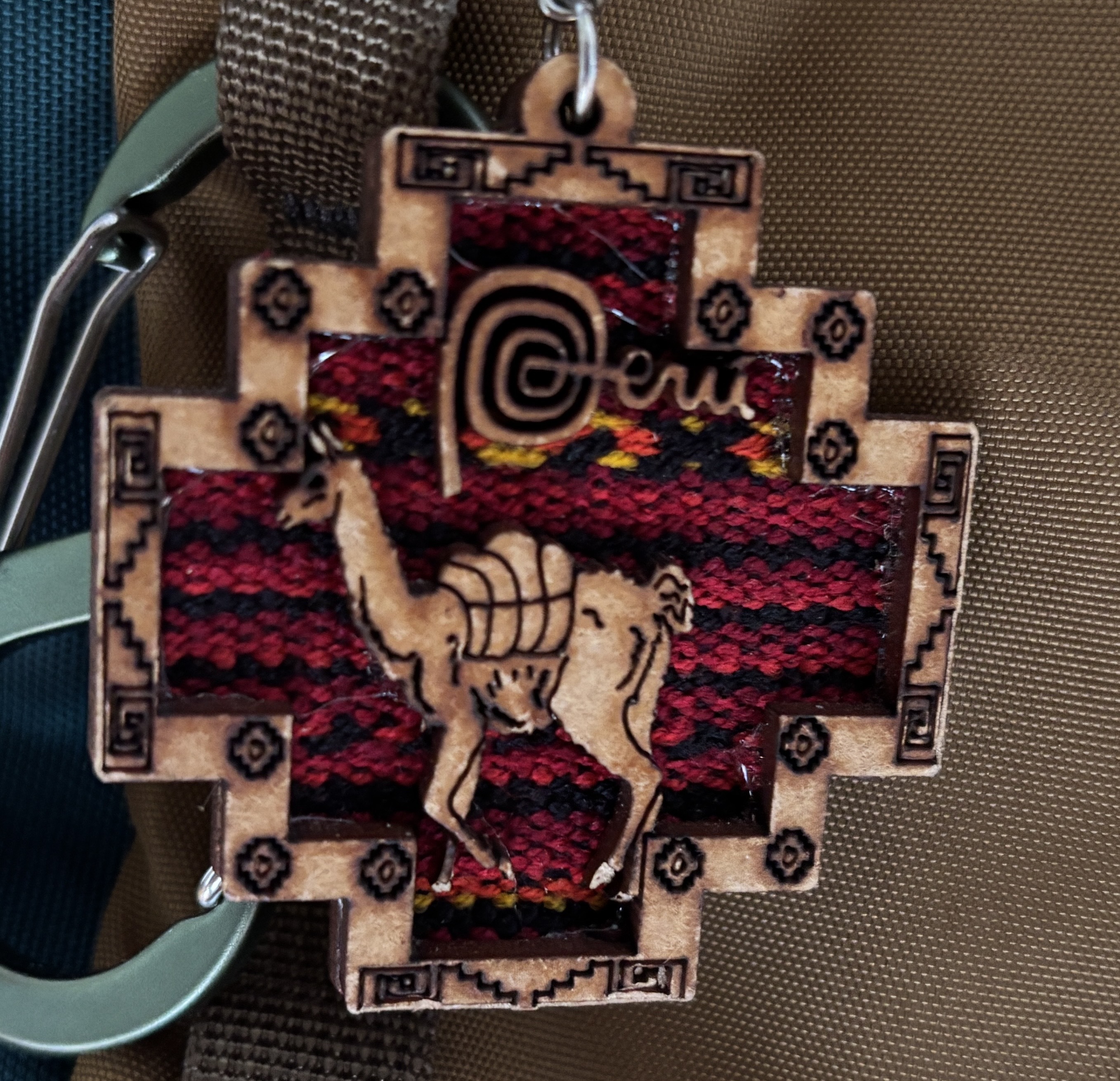
While walking around Barcelona we saw a store called “Inca” with a bunch of products that looked “Native”. I HAD TO GO IN. I was fully expecting there to be almost offensive level of appropriation and “authentic” knick-nicks. And while I did see many of the things I would assume to be appropriated, I also then saw a keychain with a chakana on it. The chakana is a symbol of Peru, and it has also become a symbol of my path to me, and also is a large part of my personal logo. But it is the first time (in person) I have seen a chakana for sale. It got me thinking that this might be something. I saw some cool flutes, bags, jewelry. And I saw some in-expensive rings with symbols carved in them. And while I wanted some of the items, I realized I tend to get over excited and just bought the chakana keychain.
In another shop, I saw something about the Inca. Near our apartment, I saw a Peruvian Restaurant, and finally I needed to understand about the connection between Peru and Barcelona. After searching online and reading for a bit, I learned that there have been large waves of immigrants from Peru to Barcelona for over 150 years. And understanding the feeling of cultural and literal genocide by a larger power ~ Barcelona opened their arms to the Peruvian immigrants. Which means that, The Inca store I was in, was authentic. There really were Peruvian natives that were carrying forward their culture and faith in Barcelona. And my Misa told me, that if I made it back downtown, I needed to go to that store, and buy one of the rings with a chakana pattern. (We did end up going back and purchasing one.)
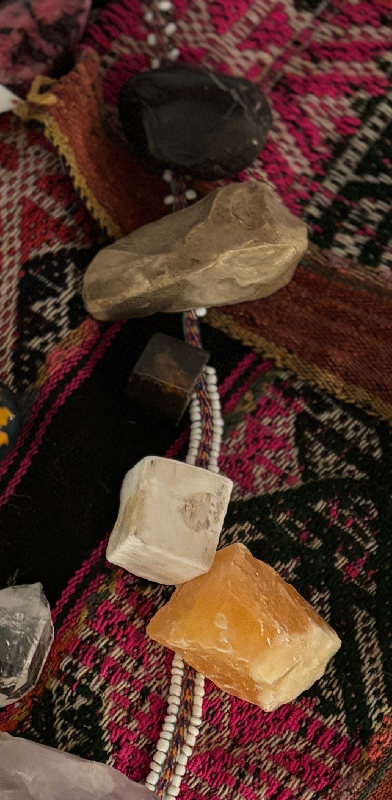
Let’s fast forward to San Sebastián. When I arrived in our apartment here, my Misa wanted to be opened. When I opened it up, it was being very specific on how each pieces was to be placed. I did not intend to set this up for a reading, but simply how I open it up in a new space as a bit of a welcoming. My Misa told me to place a specific Khuya on top of another Khuya, but rotate it specifically to point towards the East. It told me to stack several other pieces. It told me to put a flat item to stack on top of a spherical item. And I was like, this is honestly not going to work. And they said, Why else did we ask you to get that ring? And that is when I realized that this was a reading for me.
Before I tell you about the reading, let me tell you about the trauma I now know it is about. I would like to preface this story with: my shadows are not other people’s responsibility. I know that my parents were doing the best they could, with what they had.
When I was 7, I learned I had a dad because my father showed up on our apartments door step. Within a few days, we left my mom and sister for me to go away with him for a year. I did not recall anytime in my life that I had left our tiny city. (Compared to today, 1987 Traverse City feels tiny.) We left in a car I had never seen with a guy I met a few days before to visit places far past where I had ever been. We were planning to go to the military base he lived on in Heidelberg, Germany. But as my father was so excited to see me, and to introduce his only son to his family, we went to Puerto Rico first. In Puerto Rico, nobody but my father seemed to speak English. My grandma, her partner, my aunts and uncles, and my cousins. I remember that a couple of my cousins spoke English well enough to include me in some things, but overall, I felt more disconnected from anything safe than I ever had in my life. I learned that this part of my family, who were so welcoming and kind, and wanted so badly to invite me in, felt to me like they were behind a sheet of glass, because I could neither speak to nor understand them. I was determined to learn this language. And promptly, we left for Germany.
I remember that when we got onto the military plane, I was handed a plastic baggy with a fruit roll up, ear plugs, and some ibuprofen. My father and I were sat in a strange row of seats next to the TANK that the US was flying to Germany. And when we landed in Germany, I met my step-mother, and step-siblings. They were from Atlanta, Georgia so we spoke the same language, but goodness did we have different outlooks on life.
This was probably the most traumatic year of my life. Nothing felt stable, nothing felt safe, nothing felt solid. I made friends on the military base, I went to school, I was a kid. And outside of the tiny bubble that was our base, nobody spoke English.
I remember a couple of times where I would go on Volksmarches. Looking it up now, I see that this term is for a non-competitive peoples march across Germany originally set up in the 1960’s. We would go miles and miles and miles. But I wasn’t a runner, and no matter the level of competitiveness intended, my dad wanted to win. (To be fair, he did win the several marathons in Germany that year.) But I remember walking from town to town, knowing my dad would meet my at the finish line. There were a couple that my step-siblings went with me on, and then a couple where they refused. So there was a 7 year old me, walking across the German countryside, with hardly a word of German, and looking for the end of the path. (People were very kind even if they couldn’t speak to me, people fed me in the towns.) I also have a very powerful and fond memory of one time that I was still with my dad on one of these volksmarches, and we stopped along side a country road and ate pears that were growing on a tree there.
The school did slowly teach us some German. Kind of crazy that within a month’s time, I went from not knowing that there were other languages, to feeling like I needed to learn 2 more to simply survive. My father has a very nonchalant feel about many things. I call it, “The Cabrera Crazy.” If you believe it strong enough, it is true. “Learning German was easy. I was shipped here, and I learned. That is also how I learned English.”
While it was not his intent, he made it feel like a competition. It was so easy for him to learn these languages, it was so easy for him to live life wherever he needed to. And each time he would note his skill, I would feel like it was a dig on me that I didn’t instantly pick up these languages. I started feeling the shame, guilt, powerlessness, hopelessness when I was 7 because I learned of these new skills that I needed to survive and couldn’t pick them up fast/good enough. When I tried to speak Spanish, or German from the little bit I was learning, he would interrupt me to correct me. Almost every interaction with my dad, was him trying to show how well we could connect, and make it exciting for me to want to be near him. And I often could only see that he could do so many things I couldn’t, which would amplify my shame.
We lived together for that year, and through out my life after that, I traveled with him a couple of times to see Disney World, or go to Puerto Rico to see his family (my family). And each time, it amplified my shame. It amplified my fear. It amplified my inability to learn the language(s) that I felt was a live or die paradigm. Between the ages of 7 and 14, there wasn’t exactly great places for a poor kid in Traverse City, MI to learn a language. But I felt like I was expected to know it since the last time we had met. Until one trip where my dad seemed to finally decide that I would never learn Spanish and he would just do the communication for me. This really amplified the fear and shame that I had as it confirmed their validity.
While I was back in Michigan, my junior high school started offering Spanish classes. I tried to take a class every semester because I was so determined to learn it. I nailed the accent, I nailed the composition. Actually, learning Spanish in class helped me understand the structure of English a lot better. But I couldn’t do homework. Anytime I would try to sit at the dining room table to do my Spanish work, my mother would tell me to “Stop that, you sound like your father.” So I would go to my room. I would practice from my room, and my step-father would come into the room and yell at me because “your mother told you to stop that.” ~ This was a special kind of ironic cruelty because I frequently would get punished if I get less than A’s on my report card. But this took something I already felt so awful about, and added on the feeling of sounding like my dad is clearly a BAD thing. I felt like I must be bad for speaking my dad’s language, and sounding like my dad.
Between them, I got the overall feeling that I was in a competition that I didn’t consent to join, nor did I know the rules, and I had no basis to start. By the time I had a chance to start learning, my only stable adult figure told me that I sounded bad for trying. But I was still so persistent on learning because I was so excited to know my family better, and my teachers were so amazing. I remained quite conflicted.
Then there were times that I would travel. I have been to several Spanish speaking countries. And each time I tried to speak Spanish, it was like I had to have an internal duel with these voices cutting me off to correct what I was saying, tell me I was bad, and that they people wouldn’t hear me anyway. As I had the accent, and clearly look hispanic, people would look at me like I was really stupid when I would start speaking, and then not know a very basic word. This amplified everything.
I continued taking Spanish classes. I got to the point where there was nothing new I was learning in the classes. I knew all of the words, but couldn’t speak. I didn’t realize that I was blocked, only that I couldn’t do it. (This is probably also amplified by the fact that I am dyslexic and I always simply assumed I was dumb with learning.)
Continued learning. I had a 500 or 600 day streak on DuoLingo until something glitched and my streak went away. I gave up, I picked up again a year later. Got a 365 day streak. I started to see how the errors I would get in the lessons were not because I didn’t know the words, but they are the same errors I would make on a test in my native language, and I lost it again. Then I noticed all of the “once funny” emotional manipulation that the stupid application and icon gave me. I simply deleted it from my phone. And I gave up. I refused to try any longer. And when I say I gave up, I mean that despite trying to learn Spanish for almost 35 years, I am just not trying anymore. I can accept that I will never speak to my family, I can accept that I will not be open to all of those connections and relationships that I want because I am simply too angry and hopeless.
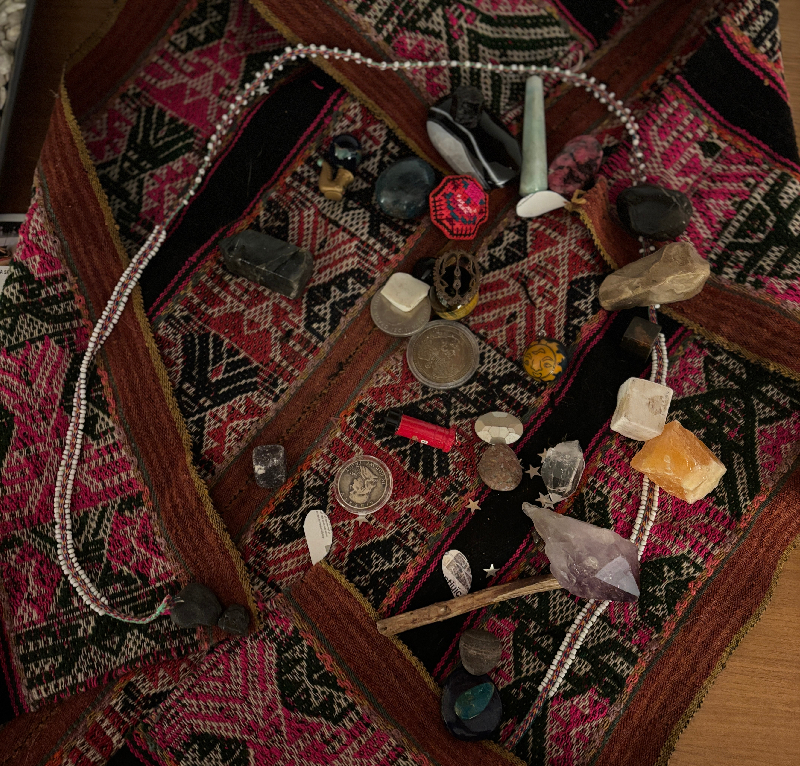
Now, I cannot teach you to read a Misa. Reading a Misa is a skill onto itself that is learned through the process of becoming a Paq’o. But this particular Misa is built with and from me and my experiences. It speaks to me on a deeper level than it can others. Reading a Misa is most often a process of starting where I am drawn in the Misa and starting to explain the pieces I understand from looking at each piece, how it is connected to the rest and where energy appears to be flowing to tell a story. With this reading, it was almost like it just told me the full story. I guess this is kind of like when you first learn to read, you have to look at the letters, sound them out, and then understand there is a word, and then put the words together to form a sentence. Up to when you look at a page of text and scan to get the contents so you can quickly get to the next page. But let me break out the smaller pieces to help the you understand. I would like to start in the south of the reading. (Bottom of the image above.)
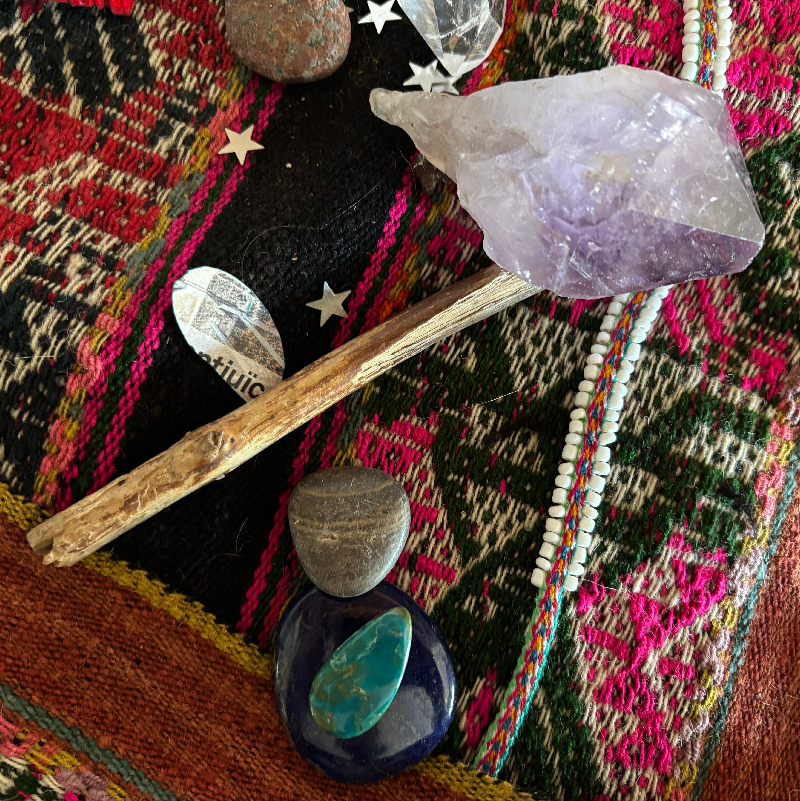
The relevant stones we see here are:
(1) Anger Stone (Lapiz Lazuli)
(11) Love/Condor (Blue Peruvian Opal)
(13) Mystery/Jaguar (African stone)
(18) Persistence (Amethyst Crystal)
(C) Younger child/Student/Mentee (Stick)
1 leave of the Kintu (prayer leaves) increasing energy towards the stones
End of the beaded cord. (Divider between in-body and celestial affect)
From this, I read: With the increasing energy flowing from the center (Cuzco), the connection to (C) those who need the skills I have to use and teach is helping to heal the (1) anger and (13) pieces I don’t understand about language and connection to the greater world (physical and metaphysical) through (11) love. I read this as directly, my family here with my on this trip, and less directly, those mentees and students I have, any members of our coven that wish to learn from me, and all of the possibilities beyond are working towards opening up while I battle the shadows I have around language.
With a flash back to the EFT session I noted above, I saw that this process was working towards allow me to release this shadow. (FINALLY!) From here, I looked to the north where the Release Khuya was sitting to read the north.
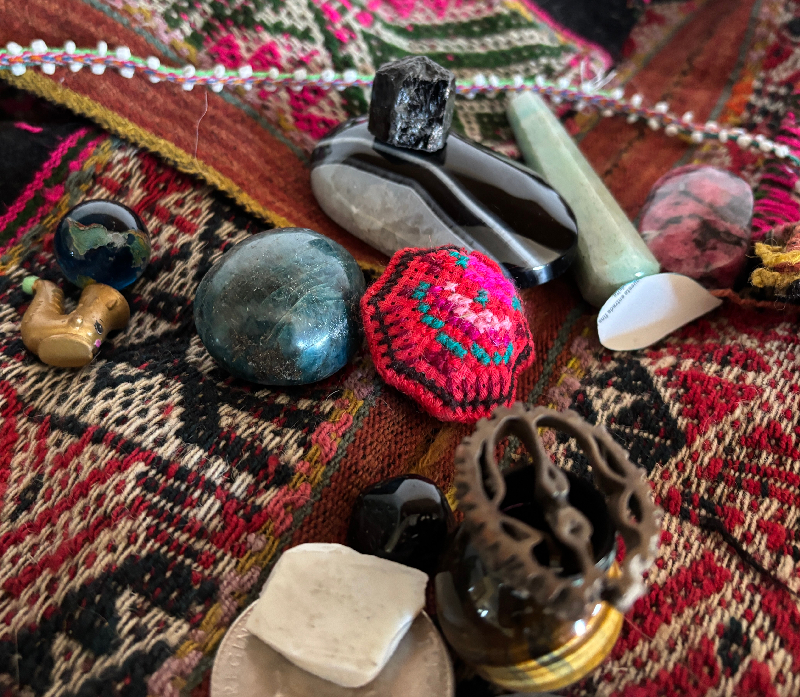
(E) Mentees/Students/Children (Toy Saxophone with world marble)
1 leave of the Kintu (prayer leaves) increasing energy towards the stones
End of the beaded cord. (Divider between in-body and celestial affect)
The energy is slowly flowing to the (15) Release stone because clearing this shadow is rolling a bolder up hill and nothing in a person WANTS to do that. But where does the energy come from? (9) Vulnerability has been conflating (16) Stress/Anxiety energy for a long time. But with the energy from those (E) who need me, (9) Invulnerability is allowing (2) Relationships to help diffuse (16) Stress/Anxiety and as that is abating, the energy from this teaching and divine space is starting to flow slowly to the (15) Release stone. The (A) Larimar is helping to uplift the efforts of all of this from a teaching space, to a divine space, where it used to simply be a blockade to that energy.
This two above really illustrate 90% of the message, but most of the remaining Khuya that were part of this reading were in the East.
The relevant stones we see here are:
(3) Fear (Black Agate)
(8) Space/Time (Beige Igneous)
(10) Elder/Teacher (Michigan White Alabaster)
(6) Hero/Leadership (Citrine)
End of the beaded cord. (Divider between in-body and celestial affect)
The flow of energy coming from (15) Release is cascading down through fear, lightening the weight of (8) Space/Time and starting to improve my abilities with teaching and leading, which are all empowered by love.
All of this goes back to the basic reading I had initially. You now have the capacity to deal with this shadow, and with the EFT I released it. And this is a huge step towards helping me, my immediate family, my greater family, and the world in which I choose to offer up my energy.
Semi-frequently people will ask me about dating. Recently, a good personal friend asked me if I had any advice on stepping into a poly relationship. And here is the thing: I feel like I have never dated, and I know almost nothing about poly relationships. I met my partner when I was a senior in high school. They were a sophomore. We have been together since I was 17, and they were 15. So there is a whole world (particularly with modern internet connections/dating apps) about the intro to relationships that I have almost 0 context to.
Dating is about putting out feelers and trying to understand how the man/woman/human across from you can go from a beautiful face and witty yet kind charm, to someone you would be happy to offer a cup of tea when you know there is nothing more you can do to ease their suffering. And other than the potential number of people involved and how/when they are part of the relationship, poly relationships** are no different.
The aspect of relationships that I have been… studying?… are about how to maintain and grow them over long term. AND my suggestion is that the rules I put forward for relationships can only be true here too.
My partner and I are currently traveling as part of a commitment we made on our honeymoon. On our honeymoon, we agreed that in 20 years, we would come back to Spain with our children. (One of our children ~ who is now a legal adult ~ didn’t want to come, so out of our control.) So, after 20 years, where we have both done our personal work, we are still working at growing and improving, and we try our best to achieve our agreed upon commitments, here are some of the things that we have come up with.
If you would like your relationships to last, and I suspect that these are true for dating or opening yourself up to a relationship in any way:
Learn about and understand the concept of CONSENT deeply.
Put down your mask and be as honest as you can. We all have masks that we may not even know we are wearing. Don’t let this hinder you. Be as honest as you can, right now.
If you worry about things about yourself that you fear might not allow this relationship to work, which we all do: Relax. Everyone has their skeletons. I do recommend being honest in sharing concern and offering vulnerability ~ This is always a recommendation, however; as a matter of safety, it is ok to get a few dates in to see if that vulnerability feels potentially safe. (Reminder: situations where you are incredibly vulnerable are NEVER easy to share, so you have to decide a time that you are willing to take the leap.). When you can share your vulnerability, a partner worth having will be aware of the gift you have given, and feel safer in sharing their vulnerabilities with you.
Listen. Actively listen to what they are saying, and what their body language is sharing. Listen to hear their meaning, and any time you have something come up that you want to comment on or refute, hold onto it, keep your mouth closed, and listen. When they are done sharing, it is worth asking if they are willing or able to hear your input. This will make things SAFER for them to be honest. And if they say they are NOT able or willing to hear your input. Drop it. Do not find a way to share your input anyway. Honor their consent.
Feel your fucking feelings. This is our second house rule. And yes, we keep the swear word when we share this with our kids. It is an important part of the sentence. We, ourselves, need reminders that it is hard to acknowledge, feel, and process our own feelings. Even with this much work, it is still difficult. And we need to do it anyway. Happy? Do a cartwheel. Sad? Sulk on the couch with a cozy blanket. Angry? Let people know you are feeling anger and clarify that you are going to scream into a pillow and see if you can let it out. Then go do it. (I have added the let people know part because I am always afraid that my anger shapes the people around me in a way that feels abusive to me. If I can say, “I am feeling angry, and it is not about you, I need to go process.” can give me space to feel my big emotions without affecting others.) Also be very careful, You need to feel your feelings, but you may NOT abuse people with them. Even if you are angry at your partner, they actually cannot make you do anything, even feel anger. If their actions are causing you anger, Feel your feelings, and after you have felt your feelings, then have a clear conversation about what happened. Their action did not cause anger in you, the anger comes to you because the way you perceive or speculate about their action brought the feeling to you. Re-read that sentence, it is important. If you feel they caused it, you will be guilty of bludgeoning them with your anger when you try to talk, as you will undoubtedly raise your voice.
Feel comfortable in your discomfort. Other people experiencing their big feelings prompts most of us to want to fix it. (Dudes and chameleons, I am especially talking to you.) The best thing you can do to “fix” it, is let them be, and know that it is not about you. It is ok to say something like: “I see you are in your feelings, if/when you would like, I would like to be available for you.” This is so hard. But seriously, take that time to think about why you automatically assume it is about you when someone near you is processing big feelings. Let them feel, don’t make it about you. What if it IS about you? Trust that after they process, they will bring it to you to address.
The hardest thing to say is the thing you need to say first. Often, we get bent out of shape because there is something that we are feeling that we don’t feel safe sharing for one reason or another. This creates a breeding ground for miscommunication. I will often start the conversation with (as it will never have an easy-in to the conversation it feels like I must blurt it out.) “As we agree that the hardest thing to say is the thing I need to say first: … … … (say the thing)… … …” Then I let them process it. Then we talk. THIS SUCKS EVERY TIME. But, now we know the same things and understand each other’s feelings on the topic. It is amazing how much pressure this diffuses in our everyday.
Create and communicate a Safe Word. One thing that the Kink community does beautifully is work with Safe Words. This talks about consent, and a safe space to push past potentially uncomfortable situations, but always have a safe way to back up. Oh, I don’t actually like this, I would like this to stop right away. Then you can experience something you want to try, without guilt or pressure or anger about another persons involvement. You get to consent to everything. So, agree upon a word that you agree to use, and agree to the terms of using it. It must be a word that is not an everyday word as to avoid confusion. For us, it is a word you speak and everyone in the situation stops, steps back, and thinks about what is going on. Preferably, trying to see what you might not have already heard. Once you have a moment where you have stepped out of your initial emotion or response, you have a much clearer means of stepping back into conversation (or whatever) allowing you to approach it being who you wish to be. If there is conflict, being able to step back feel your fear or anger, understand why it is there, and then stepping back to the conversation can allow everyone to safely communicate their feelings and experiences in a way that others can hear. As a group, you get to consent to hearing the positive and negatively judged emotions that people around you are having. Our kids tested this for a long time to know it was real. Imagine a tickle fight with a 3 year old. They scream and laugh, and they say “No” or “Stop” and you stop, and they are like, why did you stop? The words “No” and “Stop” are part of the game for them. But if they say “lamppost”, “lunchbox”, or “tofu” (whatever your safe word is), everything stops. We would be in the middle of a WWF style all-out-tickle-battle-royale and they use the safe word. Everyone freezes. Then they say go, and after 2 seconds, they say it again, and everyone freezes. Basically, we had a lot of tickle fights that were like someone hitting pause and then play again 15 million times because they needed to know that it would work all the time.
Care/Be Authentic. It seems like it doesn’t need to be stated, but it does. If you do not really care, you cannot do any of the above from a place of authenticity. Being authentically you allows you to show your consistent self, and let them decide if they feel safe with who you are. To do this, you must care enough for them, to be honest with them… And even more difficult, you must care enough about YOU, to be honest with yourself.
Because this list is crying out to be rounded up to 10: Act everyday so your partner chooses you again tomorrow. Remember, even if you are married, you are not required to stay together. Your partner could leave. My partner could choose to leave. And as I do not wish that to happen, I try to grow every day. I try to be the partner they need every day. And I do it all with the hope that they will choose me again. If I can do this, and she chooses another way tomorrow, I will be sad, but I also know that the authentic person that I am, is not what they need right now.
And this brings me to the point that no relationship fails. It continues or it doesn’t, and you learn from it.
While this is not a clear list that is directly applicable to your first date that you coordinated from the Internet, I think that reading it through can help you to see what you really want from this date. Assuming you are interested in this dating becoming something more than a 1-night situation, I feel as if this list can help you understand who you are hoping to meet, where growth is possible, and if this is a person you want to spend time with. While laying the ground work for sharing with them who you are, and letting them understand that you have hopes and boundaries.
This list is the clearest words currently know to help a relationship last long term. Wishing you all the best.
** Foot note, I asked a friend of mine some details on poly relationships. While he might have feared I was fishing for potential partners, I really simply wanted to understand. I have a full life, full time job, several hobbies, a partner, 2 kids ~ I do not have enough time to spend with the single partner I have. So I wanted to understand how one can offer the dedication and connection to multiple partners, when I cannot even figure out how to do that well enough with my 1 partner. His answer was so incredible. It came down to communication about boundaries, being clear about what you are hoping for from each partner, and above all else, desiring nothing more than for your partner(s) to be happy. Enjoying the process of them being happy. Them being happy as a high priority for you and a fulfilling part of your connection. I was simply blown away. Basically, he described a perfect relationship. Boundaries, and offering joy without the complexity of your own ego obstructing the way.
Some of the most hurtful things that most of us experience come from relationships ending, being abandoned, kept away, or exploding. I have heard and been asked so many questions either directly about relationships, or are at the heart of those same questions. I often say that my religion is relationships. It is important to say that all of the times I have said this, I have not really been joking.
Relationships, as in a connection you hold either another individual or individuals, are something I find so incredibly fascinating. I spend a lot of time contemplating aspects of relationships and how they can grow or be grown to help people be a healthier version of themselves (by their reporting, not my judgement.). This means that I am still not perfect. I struggle. I still have certain people with whom we seem to have slightly different languages or our various individually held traumas present in ways that we cannot quite solidify the relationship I want – even when I might be able to see the holes in that relationship. The pieces I understand though, seem to hold truth in each relationship, even when the connection goes sour and people cannot reclaim it.
I see 5 rules for each person in a relationship to follow for success.
You must care for yourself
You must consent to picking up and holding onto a connection
You must maintain your own boundaries
You must be willing to give to this connection without expectation of return
You must be willing to grow
You must care for yourself enough that you can invest energy into a connection that will not bring your energy reserve to or below empty. I remember my youngest coming home from kindergarten and sharing with me that he has to fill his cup before he has anything that he could use to fill someone else’s cup. (Thank you Mrs. Larrea.) It never ceases to amaze me how our children see and say things that simply cut through all the complications and simply nail the important sentiment.
In order to be in relationship with another person, you must commit to fulfilling your needs. This is NOT selfish. This is not a situation where you should: “get rid of some of your needs.” As George Carlin put it. If you have ever built anything, let’s say a house out of building blocks, you cannot build an epic skyscraper if you have no foundation. If your garage is technically standing up but you know how poorly it is constructed, you cannot build a fancy mother-in-law suite over it. And each of us have our own set of needs, and those cannot be questioned or compared to another’s needs. Yes, we all have physical needs like food, water, and sleep. But there are essential mental/emotional needs too. Some people need alone time, some people need the opposite. Some people cannot feel awake or connected without a cup of coffee, a morning routine, or even a walk in the woods. If you can take a few moments to think about the things you do that allow you to feel better, more connected, and stronger in the day, what happens if you make sure those exist in your everyday life? You find that you have the resources to be the person you want to be in the world. You find yourself capable of being part of a caring relationship.
You must maintain your own boundaries. Many of us don’t know what boundaries are in this context. Or feel like they need to be given permission to have and hold them.
My favorite description of a boundary is: the distance in which I can love you, and still love myself. A boundary is a rule that people must agree to follow to be in your life. For instance, you must be 4’ 11” to ride this roller coaster. This is a boundary. You must pay $10 to gain access to the fair. This is a boundary. What is your price of admission? How tall does someone need to be to ride this ride? Please delightfully take that as dirty as you need. The idea is actually quite simple though.
What are realistically some boundaries you might set? To be in my life…
a person will not intentionally cause me physical, mental, or emotional pain.
a person will not actively support someone who will cause me physical, mental or emotional pain.
a person will listen when I identify that something they are doing is harming me.
And maybe you have some more specific boundaries (a higher bar) above and beyond the previous for people who are closer to you. A partner or inner circle. To be in my inner circle…
a person must hold trust with me.
a person must be willing to do the work to come back into integrity if something is broken.
a person must consider my welfare in scenarios that affect me (within reason)
All of these seem very basic and simple to me. And while I do not want to over simplify a complex situation or blame a blameless victim, how many people would never tolerate a person on the street to hit them, but don’t speak up or hold the boundary for someone who is supposed to love them?
Take time to think about and define your boundaries. Be honest with yourself and the person with whom you are in relationship if a boundary of yours is being pushed or breached. Defend your boundaries: do not allow ANYONE to push you past where you are comfortable. This seems like a battle cry when I read it to myself. It is not. It is actually very basic self care. I am saying that if you are writing a paper, and are using your last pen, don’t let someone take your pen from you. Also, one thing that comes up every time when discussing boundaries is that people are hesitant to contest with a friend over something that you could just let go. This is always an option. But know that there are consequences to this route. If you let someone cross your boundaries, you are actually being unfair to them, and building a scenario to destroy your relationship. If you try to defend it later they are curious why it is “all of the sudden” bothering you. If you never defend it, you build resentment until you snap and explode the relationship. If you cannot be honest about your boundaries with your friends, and have support, you and that person are not honoring the rules of relationship. If they are not harming you on purpose, a simple “Can you please not do this thing, it hurts me.” should never be a conflict.
You must consent to picking up and holding onto a connection. I look at relationships as being a third-party entity between 2 people. For instance, I consider my marriage as being an individual that is a third party to the relationship between my partner and I. I invest in her, I invest in our marriage, and she does the same. This helps me to remember that there are tasks and energy that has to be given to something for our relationship that is not a task I am picking up for her. I am picking it up because I consent to, and want to continue this relationship. Everyday we have a choice. And I want her to choose me again when she wakes up in the morning. This is made easier if she doesn’t have to do all the work to maintain our marriage while also doing stuff for me.
What is consent? By definition, it is “permission for something to happen or agreement to do something.” I think that is clear enough. But so many people do not understand consent. Or perhaps, they understand consent, but not how frequently you are going along with something and not giving consent, or how frequently you need to verify that someone is offering consent.
Everyday, every hour, every minute: someone can take away consent. If someone lent you their car yesterday, that does not give you permission to take their car today. Consent is always temporary.
So what does it mean to consent to pick up and hold onto a connection? It means that you are consenting to try. You are consenting to re-evaluate at a later date to decide if you still consent to this relationship. (Which, of course, means reviewing this whole post again each time.)
You must be willing to give to this connection without expectation of return. When I refer to “giving” please know that I am not only talking about items. I am talking about gifts, money, time, energy, or care. You are always responsible for making sure you are only giving what you are able and willing to give. But when you give something that you can give, you do so without expectation that they will return something to you, or that they owe you something. How often do you hear someone make a comment about how someone feels like their friend or family member owes them for all they have done. This is not reciprocity. This is a transaction. And it is a transaction that is not communicated, nor is it consented to. This is the same as going to a coffee house and saying, you owe me a coffee because I tipped you extra last time. Basically, in this scenario, if you cannot give something freely, do not give it. If you can give it, and are willing to give it, but will be upset if they decide to promptly give it away, do not give it. Once you give a gift, you are showing your care and offer by bringing it to them. Once they own it, your opinion no longer matters. Your care was shown. They received the energy from your gift. If you cannot accept this, please deeply consider this in regards to the gifts you give.
You must be willing to grow. You must be willing to “do the work” to heal or grow this relationship or even yourself when your own trauma or triggers negatively impact the relationship. Once again, you are responsible for honoring your boundaries, and someone asking you to change, might always cross them. But when you see a relationship struggling that you want to succeed… Sometimes the answer to your introspection needs to be that your own issues, challenges, or trauma are not allowing you to receive what this person is offering. And you cannot expect someone to receive what you offer them, if you cannot do the same.
This is a big and deep piece. First of all, what is a shadow? In summary, it is a part of yourself that you judge poorly so don’t want to admit to. So often, a relationship struggles due to communication. Problems in communication can come from you saying one thing, and it being interpreted as something else. Sometimes this is just miscommunication. Sometimes, this is because you are triggered by an innocent word your friend used.
They are talking about an experience they had at their doctor’s visit, and you are triggered due to your negative experiences with doctors and you can only hear that she is gloating over you for her good experience. While this is a fictional example, it is actually an accurate representation of this problem.
Looking at it from the outside you are like, why on earth is this a big deal? And I am sure you have felt this before. From both sides. This complex internal situation is often coming up because you have some real, deep, and probably harmful experience with whatever that trigger word was. Example above might have been “doctor”. Doing the work here might be looking into your memory and trying to find the situation that brings this to mind and has you experienced that emotion. It might be a single experience, it might be a series of experiences. It is also, most-likely, an echo of something that happened prior to this issue. This can be time you spend thinking about your past. This could be some real deep emotional processing. Please do not hesitate to request help here. If you have a good shaman or counselor or therapist. It is important to have support because sometimes, you are not ready for what you find. When you block out memories from the past, it is because you didn’t have the tools to process them safely. When you re-open that door, you still need to process that stuff. If you do not yet have the tools, it can be incredibly traumatic.
And to be a friend worth keeping, you must be willing to participate on the reciprocating end.
You must be willing to offer your friends you wish to keep: 1. the space to care for themselves, 2. the opportunity to give and take back consent, 3. the space for them to hold their boundaries, 4. the ability to receive with grace, 5. Stand up and ask for the work you need of them.

 Send to Kindle